 How-to
How to Safely Remove Algae From Metal Roofs
Table of Contents
- Why Algae Grows on Metal Roofs and How to Spot It
- What You'll Need Before You Start
- Step 1: Prepare the Roof and Surrounding Area
- Step 2: Choose the Best Cleaner for Metal Roofs
- Step 3: Apply the Solution and Allow Contact Time
- Step 4: Rinse With Low-Pressure Water to Remove Algae Safely
- Metal Roof Cleaning Tools and Soft Washing Metal Roofs
- Prevent Moss and Algae on Roofs: Maintenance That Works
- Frequently Asked Questions
Last Updated: October 20, 2026
Why Algae Grows on Metal Roofs and How to Spot It
Algae on a metal roof shows up as dark green or black streaks running down the panels, usually starting near the ridge and spreading toward the gutters, and it's the first sign you need to remove algae.
The roof itself isn't the problem. Algae feeds on moisture and airborne particles that settle on the surface.
Algae is a moisture-loving organism that stains metal roofing with dark streaks and holds water against the panel surface. Moss is different: it grows in clumps and traps debris in the pans and fasteners.
How to tell what you're looking at:
- Algae: flat, dark green or black streaks, no texture
- Moss: raised, fuzzy green clumps, usually in valleys and near fixings
- Mildew: powdery patches, often on the shaded side
That last one matters. Many homeowners mistake faded, chalky paint for algae and scrub at it, damaging the coating further. If the surface feels powdery rather than slimy, it's oxidation, not algae.
What You'll Need Before You Start
Get your gear together before you climb anything. A half-finished job with the wrong tools is how roofs get damaged.
- A roof-safe, pH-neutral cleaner (more on this below)
- A pump sprayer or garden sprayer
- A long-handled soft-bristle brush or mop
Skip the high-pressure washer (see Step 4), and skip steel wool and hard brushes too, both scratch painted metal and open the door to corrosion.
Read the roof manufacturer's instructions first. Most Colorbond and painted metal warranties specify which cleaners are acceptable, and the wrong product can void that warranty.
Step 1: Prepare the Roof and Surrounding Area
Preparation protects two things: your garden and your roof coating.
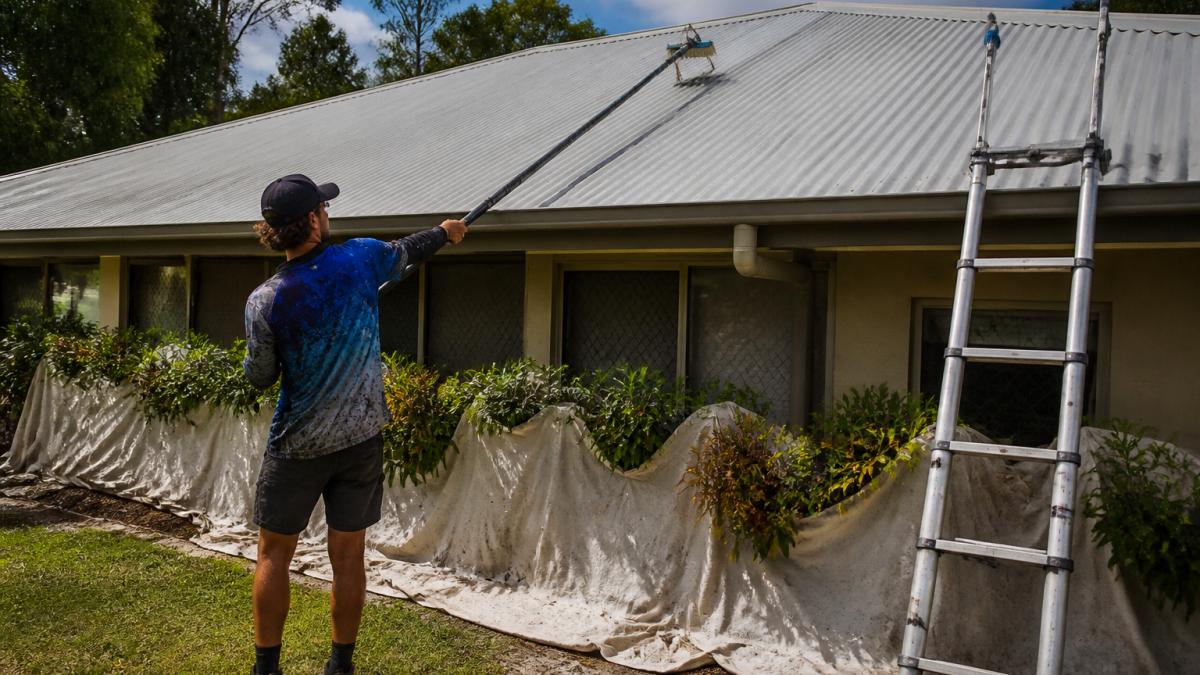
Start from the ground.
Next, clear leaves and debris from gutters and valleys by hand or with a blower from a safe position.
Then check panels for loose fasteners, cracked sealant, or lifting flashing. Cleaning around damaged fixings pushes water where it shouldn't go.
Finally, plan your access. Work from the ground with long-handled tools wherever you can.
Step 2: Choose the Best Cleaner for Metal Roofs
The best cleaner for metal roofs is a pH-neutral, roof-safe formula mixed to the manufacturer's dilution ratio. It lifts algae without attacking the paint and is gentle on fasteners and sealants. But "metal roof" is not one surface, a cleaner safe on one panel type can dull or stain another, so match the product to the finish.
How each panel type responds to cleaners
- Painted steel (including Colorbond and similar pre-painted panels): the colour is a factory-applied coating over steel. pH-neutral cleaners protect it; strong alkaline degreasers and full-strength bleach can chalk the paint, and acids dull the finish over repeated use. Follow the manufacturer's cleaning guide to keep the warranty intact.
- Galvanised (unpainted zinc-coated) steel: the zinc surface is the protection. Harsh acids attack it, and some cleaners leave a white residue that looks like corrosion. Use mild, pH-neutral products, rinse thoroughly, and avoid rust converters or acid washes unless the manufacturer approves them.
- Zincalume and aluminium: similar caution to galvanised. Acidic cleaners stain the metallic finish and abrasive powders scratch it; mild detergent and low-pressure rinsing usually handle light growth.
What the cleaner touches besides the panel
Algae cleaner does not only meet paint. It runs over fasteners, sealant beads, flashing, and gutter linings.
- Fasteners: some are coated or plated. Harsh acids can start corrosion at the fixing, which is where leaks begin.
- Sealants: solvent-heavy or strongly alkaline products can soften or shrink sealant over time.
- Gutters and downpipes: runoff carries cleaner into them. Check that the product is compatible with the gutter material, not just the roof.
Cleaner types and their cautions
| Cleaner type | Works on | Main caution on metal |
|---|---|---|
| pH-neutral roof-safe cleaner | Light to moderate algae | Follow dilution; don't let it dry on the surface |
| Mild detergent with surfactant | Light growth, dust, pollen | Rinse fully; residue attracts dirt |
| Oxygen-based (percarbonate) cleaners | Moderate growth | Check compatibility with the specific coating |
| Bleach-based products | Heavy growth | Can strip coatings and kill plants below; many warranties exclude them |
| Vinegar or strong acids | Not recommended | Acidic enough to dull painted and metallic finishes |
| Abrasive powders | Not recommended | Scratch the surface and trap residue |
A mild detergent with a little surfactant works for light growth; for heavier black streaks, use a dedicated roof-safe cleaner. Always dilute to the label ratio and never mix products, some combinations release harmful gas or damage the coating.
Safe handling and runoff
Dilute the product outdoors or in a well-ventilated area, never in a closed shed. Wear gloves and eye protection, and mix only what you need.
Plan where the runoff goes before you start. Direct rinse water away from stormwater drains where local rules allow, and keep it off garden beds and waterways. Check your council's guidance for anything stronger than mild detergent, and never pour leftover concentrate down a drain, follow the label's disposal instructions.
Step 3: Apply the Solution and Allow Contact Time
Applying the cleaner is simple. Letting it work is where most DIY jobs fail.
Apply the diluted solution with a pump sprayer, working from the bottom of the roof upward so cleaner doesn't run straight off dry growth.
Now wait. Contact time is the whole game, the cleaner needs several minutes to break down the algae.
For stubborn black streaks, agitate gently with a soft-bristle brush on a long handle. Light pressure only. You're loosening growth, not scrubbing paint.
Step 4: Rinse With Low-Pressure Water to Remove Algae Safely
Rinse with low-pressure water, working from the top of the roof down. A standard garden hose with a nozzle is usually enough.
High-pressure washing is the wrong tool on a metal roof. It forces water past fasteners and sealant, lifts paint edges, dents thin panels, and sprays contaminated runoff everywhere.
Rinse thoroughly. Leftover cleaner residue attracts dirt and can dull the finish. Pay attention to gutters and valleys where loosened material collects.
Metal Roof Cleaning Tools and Soft Washing Metal Roofs
Soft washing metal roofs is the method we use and recommend: low pressure plus a roof-safe cleaning solution, applied with care. It cleans without the risks of high-pressure blasting, but only works if you can reach the roof safely, and on most homes the safest place to stand is the ground.
A fall-prevention-first decision tree
Work through these questions in order. Stop at the first "no" and change your approach.
- Can you reach the streaked area from the ground with an extension tool? A long-handled soft-bristle brush or mop plus a pump sprayer with an extended wand reaches most single-storey eaves and lower panels. If yes, clean from the ground, the lowest-risk option most DIY jobs should use.
- If not, is the roof low-pitch, dry, and accessible from a stable, secured ladder? Only consider ladder work if the ground is firm and level, the ladder is footed and tied off, and you can keep three points of contact. Never overreach sideways, move the ladder instead.
- Is the roof steep, wet, fragile, or higher than you can safely work? Stop. Do not walk a steep or wet metal roof. Call a professional.
- Are you working alone, or is the weather windy or stormy? Stop. Never work at height alone, and never in wind that could destabilise a ladder or tool.
The ground-based toolkit
The right metal roof cleaning tools are simple, and most keep you off the roof:
- A pump or garden sprayer with an extended wand for even application from the ground
- A long-handled soft-bristle brush or mop to agitate stubborn streaks without climbing
- A standard hose with a nozzle for low-pressure rinsing
That's it. You don't need a pressure washer, on painted metal you're better off without one, and no roof anchors or harnesses are needed for a ground-based clean, which is why it's the safer default.
When to call a professional
Some jobs are not DIY jobs, regardless of how careful you are:
- The roof is steep, multi-storey, or has fragile sections
- Growth covers large areas or has been left for years
- Fasteners, flashing, or sealant are already damaged
A professional clean is the safer call in each of these cases. We use soft washing that's safe for Colorbond and metal roofs, with fixed pricing in writing before we start.
Checking the result
Once the roof is dry, inspect from the ground with binoculars or a safe ladder position. Look for missed streaks and check that fasteners and sealant came through clean. If streaks return within a few months, that points to a moisture or shading problem rather than a cleaning failure, address the cause before cleaning again.
Prevent Moss and Algae on Roofs: Maintenance That Works
To prevent moss and algae on roofs, keep the surface dry and debris-free. Growth needs moisture and food. Remove both and it struggles to return.
A simple maintenance routine:
- Clear leaves and debris from gutters and valleys a few times a year
- Trim overhanging branches that shade the roof and slow drying
- Rinse the roof lightly after heavy pollen or dust periods
Frequency depends on conditions: homes surrounded by trees and heavy humidity need more attention than open, sun-exposed roofs. A light clean every year or two keeps most metal roofs ahead of the problem.
| Task | When | Why It Matters |
|---|---|---|
| Clear gutters and valleys | 2-3 times a year | Stops debris holding moisture |
| Trim overhanging branches | Once a year | Speeds drying, cuts shade |
| Light roof rinse | After pollen season | Removes food for algae |
| Inspect and treat streaks | After wet season | Catches growth early |
| Check fasteners and sealant | Annually | Prevents water ingress |
Catch streaks while they're faint. A small patch of algae is a quick clean.
Frequently Asked Questions
Can you use a pressure washer to remove algae from a metal roof?
High-pressure washing can strip paint, damage sealants and fasteners, and force water under panels, so it is not recommended for metal roofs. Use low-pressure rinsing instead, ideally below 1000 psi, after applying a roof-safe cleaner. Soft washing metal roofs relies on the cleaning solution to break down algae rather than force. If you are unsure, a professional clean is the safer choice.
What is the best cleaner for a metal roof?
A pH-neutral cleaner or a dedicated roof-safe solution is the best cleaner for metal roofs. Mild detergent mixed with water also works for light growth. Avoid harsh bleach or acidic products that can corrode the coating. Always check the manufacturer's instructions and warranty conditions before applying anything. For stubborn black streaks, a specialist soft-wash mix applied at low pressure gives the best result without harming the finish.
How can you prevent moss and algae on roofs from growing back?
Prevent moss and algae on roofs by trimming overhanging branches, clearing leaf litter from gutters, and washing the roof every 12 to 24 months. Good drainage and airflow reduce moisture that algae needs. If your roof has a coating, keep it maintained as directed by the manufacturer. In humid climates, a scheduled professional clean is often the most reliable way to stop regrowth before it spreads.
Is it safe to walk on a metal roof to clean it?
Walking on a metal roof is risky, especially when it is wet. Many metal roofs are slippery and some panels cannot bear weight without denting. Where possible, clean from the ground using long-handled tools and low-pressure equipment. If you must access the roof, use a secured ladder, fall protection, and non-slip footwear, and avoid the task in wet or windy conditions. A professional cleaner with insurance is the safer option.
Algae streaks don't fix themselves, and the longer they sit, the more they work against your roof coating. If your metal roof is beyond a quick DIY clean, or you'd rather not be up a ladder, JetSet Power Washing can help. We offer free on-site quotes, same-business-day responses, and fixed pricing in writing, with soft washing that's safe for Colorbond and metal roofs. Get started with JetSet Power Washing and book a free quote for a spotless, algae-free roof.