 how-to
Safe Cleaning for Colorbond Roofs: A Step-by-Step Guide
Table of Contents
- Why Safe Cleaning for Colorbond Roofs Matters
- Low-Pressure vs High-Pressure Washing: What Your Colorbond Roof Needs
- Soft Wash Roof Cleaning: The Safer Method for Colorbond
- How to Remove Lichen from Metal Roof Safely
- Colorbond Roof Maintenance Schedule and Preventative Care
- Step-by-Step Safe Cleaning Process
- Step 1: Inspect your roof and assess conditions
- Step 2: Gather safety equipment and cleaning supplies
- Step 3: Prepare the area and protect surroundings
- Step 4: Apply cleaning solution and allow dwell time
- Step 5: Rinse thoroughly with low-pressure water
- Step 6: Post-cleaning inspection and protective coating
- Safety Precautions and Protective Gear
- Common Mistakes to Avoid
- Frequently Asked Questions
Last Updated: September 25, 2026
Why Safe Cleaning for Colorbond Roofs Matters
Safe cleaning for colorbond roofs protects your most valuable asset. A damaged roof costs thousands to repair. A properly cleaned one adds years to its lifespan and improves your home's appearance instantly.
Colorbond is durable, but it's not indestructible. High-pressure water can strip the protective coating, cause paint degradation, and leave your metal panels vulnerable to rust and corrosion. The wrong cleaning method turns a maintenance task into a costly mistake.
Homeowners and property managers often face this dilemma. They want their roofs spotless but fear the damage that comes with aggressive cleaning. That tension is exactly why safe cleaning methods exist. Below, we'll show you exactly how to clean your Colorbond roof without compromising its integrity or your safety.
Low-Pressure vs High-Pressure Washing: What Your Colorbond Roof Needs
High-pressure washing delivers water at 3,000+ PSI (pounds per square inch). It blasts away dirt fast but destroys Colorbond coatings in the process. Low-pressure washing uses 500-1,500 PSI and cleans effectively without causing harm.
The difference matters because Colorbond panels have a thin protective layer. High-pressure water breaches that layer. Once breached, moisture gets underneath and corrosion begins. Paint degradation follows quickly.
Low-pressure methods work because they rely on time, not force. A cleaning solution sits on the surface, breaking down mould, lichen, and moss. Water rinses away the loosened debris gently. The roof stays intact.
When to use each method:
- Low-pressure: Colorbond roofs, tiles, painted surfaces, render, cladding
- High-pressure: Concrete driveways, sealed pavers, industrial surfaces
For Colorbond specifically, low-pressure is non-negotiable. Your roof's durability depends on it.
Soft Wash Roof Cleaning: The Safer Method for Colorbond
Soft wash roof cleaning combines low-pressure water with specialized cleaning solutions. It's the industry standard for delicate surfaces like Colorbond, tiles, and painted metal.
The process works in stages. First, a mild detergent solution is applied at low pressure. The solution clings to the roof and breaks down organic growth. Then dwell time allows the chemicals to work. Finally, low-pressure water rinses everything away. No blasting. No damage.
Soft wash removes moss, lichen, mould, and algae without stripping protective coatings. The water-based solutions are non-corrosive and environmentally safe. Your roof looks new again without compromise.
When soft wash is the right choice
Soft wash is right for almost every residential Colorbond roof. It's especially essential when:
- Your roof has visible moss or lichen growth
- Paint shows early signs of degradation
- You're preparing a property for sale
- You want to avoid warranty complications
- Environmental runoff safety matters to you
If your roof is relatively clean with only light dust, low-pressure water alone might suffice. But the moment organic growth appears, soft wash becomes the smart choice.
Selecting the right cleaning solution
Not all roof cleaning solutions are created equal. The wrong product damages Colorbond or harms the environment.
Look for solutions that are:
- Water-based (not solvent-based)
- Non-corrosive to metal
- Biodegradable
- Effective against moss, lichen, and mould
Concentrate-based solutions offer better value and environmental safety. They're mixed on-site, reducing packaging waste. They also cost less per application than pre-mixed products.
Avoid bleach-heavy solutions. Bleach accelerates corrosion on metal roofs and damages surrounding vegetation. Mild detergent combined with biocides is far more effective and safer.
How to Remove Lichen from Metal Roof Safely
Lichen clings stubbornly to metal roofs. It's not just dirt, it's a living organism. Pressure alone won't remove it without damaging the roof underneath.
The safe method uses a two-part approach. First, apply a mild cleaning solution designed for lichen removal. Let it sit for 15-30 minutes. The solution weakens the lichen's grip. Then, use low-pressure water to rinse it away. The lichen releases cleanly without scraping or high-pressure force.
Never scrape lichen with tools. Scraping gouges the protective coating and creates entry points for moisture and corrosion. Let the chemistry do the work instead.
For stubborn lichen, a second application may be needed. This takes longer but protects your roof's surface integrity. Patience prevents costly repairs later.
Colorbond Roof Maintenance Schedule and Preventative Care
A maintenance schedule keeps your roof healthy and extends its lifespan. Preventative care stops problems before they start.
Annual tasks:
- Inspect gutters and remove debris
- Check for visible moss or lichen growth
- Look for paint degradation or rust spots
- Clear leaves and branches from the roof surface
Every 2-3 years:
- Soft wash the entire roof to remove organic growth
- Apply a protective coating if recommended by the manufacturer
- Inspect flashing and seals for gaps
After severe weather:
- Check for loose panels or damage
- Clear debris immediately
- Address any corrosion spots quickly
Regular inspection catches small issues before they become expensive. A annual soft wash keeps moss and lichen at bay. A protective coating applied after cleaning adds years to your roof's life.
Step-by-Step Safe Cleaning Process
Step 1: Inspect your roof and assess conditions
Before cleaning, get on the roof safely and look at what you're dealing with. Check the pitch, condition of panels, presence of moss or lichen, and any damaged areas.
Document what you see. Take photos. Note which areas need extra attention. This inspection determines whether you can DIY or need a professional.
If your roof pitch exceeds 25 degrees, hire a professional. If panels show rust or corrosion already, professional soft wash is safer. If you're comfortable on the roof and conditions are mild, you can proceed.
Step 2: Gather safety equipment and cleaning supplies
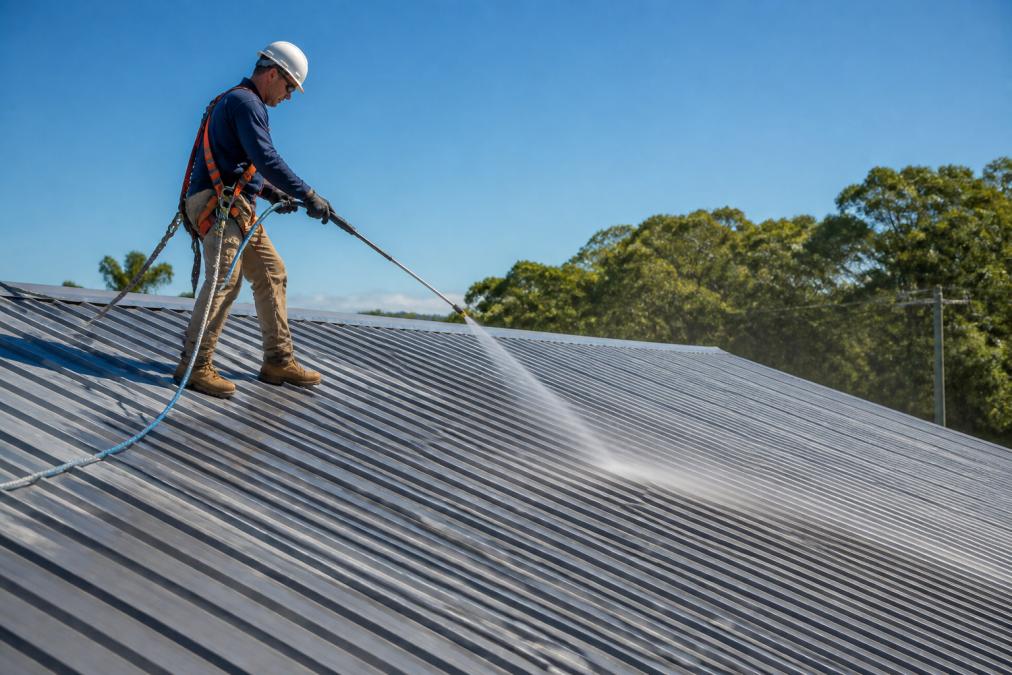
Safety equipment is non-negotiable. You'll need:
- Safety harness (essential on any pitch)
- Hard hat
- Non-slip footwear
- Work gloves
- Eye protection
- Long sleeves and trousers
Cleaning supplies:
- Soft wash solution (water-based, non-corrosive)
- Low-pressure sprayer (500-1,500 PSI maximum)
- Garden hose for rinsing
- Bucket for mixing (if using concentrate)
- Measuring cup or pump for accurate mixing
Never skip safety gear. A harness prevents falls. A hard hat protects against branches or debris. Non-slip shoes keep you stable on wet surfaces.
Step 3: Prepare the area and protect surroundings
Clear the roof of loose debris. Remove branches and leaves. Close gutters with temporary covers if needed to prevent solution runoff into water systems.
Wet the surrounding garden and vegetation. This prevents cleaning solution from concentrating on plants.
Step 4: Apply cleaning solution and allow dwell time
Start at the lowest point of the roof. Work upward so solution flows down naturally. Apply the soft wash solution evenly using low pressure.
Step 5: Rinse thoroughly with low-pressure water
After dwell time, rinse with low-pressure water. Start at the highest point and work downward. Use a fan spray pattern, not a concentrated jet.
Step 6: Post-cleaning inspection and protective coating
Once the roof is dry (24 hours minimum), inspect your work. Moss and lichen should be gone. The surface should look clean and uniform.
Safety Precautions and Protective Gear
Working at height on a wet roof is inherently risky. Proper precautions make the difference between a successful clean and a serious injury.
Fall protection is essential:
- Always use a safety harness, even on low pitches
- Anchor to a secure point (ridge, chimney, or roof anchor)
- Never work alone
- Have someone on the ground as a spotter
Personal protective equipment:
- Hard hat: protects from branches and impacts
- Safety glasses: keep solution and debris out of eyes
- Work gloves: provide grip and protect hands
- Non-slip footwear: essential on wet surfaces
- Long sleeves and trousers: protect skin from solution and sun
Environmental safety:
- Contain runoff where possible
- Wet surrounding vegetation before cleaning
- Use biodegradable, non-corrosive solutions
- Never let solution enter storm drains directly
- Check local regulations on wastewater disposal
Weather precautions:
- Don't work in high winds (solution drifts, safety risk)
- Avoid rain within 4 hours of application (interrupts dwell time)
- Don't work in extreme heat (solution dries too fast)
- Early morning or late afternoon is ideal
Common Mistakes to Avoid
Mistake 1: Using high pressure High-pressure washing damages Colorbond coatings and causes corrosion. Stick to 500-1,500 PSI. Low pressure combined with chemistry works better and safer.
Frequently Asked Questions
Does pressure washing damage Colorbond roofing?
High-pressure washing can damage Colorbond by stripping the protective coating, causing paint degradation, and creating entry points for water and corrosion. Soft wash and low-pressure methods (below 1500 PSI) are much safer for Colorbond roofs. Always use a fan nozzle and maintain distance to protect the surface integrity of your roof.
How often should a Colorbond roof be cleaned?
A Colorbond roof maintenance schedule should include cleaning every 12-18 months in tropical climates where mould, moss, and lichen grow quickly. In drier regions, cleaning every 2-3 years may suffice. Regular preventative care extends roof durability and maintains the protective coating, preventing corrosion and costly repairs.
What cleaning solutions are safe for Colorbond roofs?
Use mild detergent, water-based, non-corrosive cleaners specifically formulated for metal roofs. Avoid acidic or abrasive chemicals that degrade the protective coating. Diluted solutions designed for soft wash are ideal. Always rinse thoroughly after application to remove all chemical residue and prevent surface damage or warranty issues.
Can I clean my Colorbond roof myself, or should I hire a professional?
DIY cleaning is possible if your roof pitch is low and you have proper safety harness equipment. However, steep roofs, high heights, or stubborn mould and lichen require professional expertise. Professionals have trade-grade equipment, insurance, and knowledge of PSI settings and chemical application to avoid warranty implications and damage.