 How-to
Does Soft Washing Remove Oil Stains?
Last Updated: October 23, 2026
Quick Summary
Does soft washing remove oil stains? Soft washing can lighten oil stains when paired with the right degreaser and dwell time, but it usually does not completely remove deeply embedded oil without agitation, heat, or pressure washing as a follow-up step.
- Fresh oil spills under one week old usually respond to a single degreaser treatment with dwell time of 10 to 20 minutes.
- Old stains over 6 months old require multiple applications and often pressure washing afterward, with realistic expectations of 70-80% improvement.
- Soft washing relies on chemical action at low pressure and is safe on delicate surfaces like sealed concrete, pavers, and asphalt.
- Degreaser must be applied according to manufacturer dilution ratios, typically between 1:4 and 1:10 for general driveway use.
- Concrete sealer applied after treatment prevents new oil from soaking in and makes future cleaning simpler.
Table of Contents
- Does Soft Washing Remove Oil Stains?
- Why Oil Stains Are Difficult to Remove
- How to Remove Oil Stains from a Concrete Driveway
- Pressure Washing Oil Stains from a Driveway
- Best Oil Stain Remover for Concrete
- Removing Old Oil Stains from Concrete
- Soft Washing Versus Pressure Washing for Oil Removal
- Preventing Oil Stains and Protecting Your Surfaces
- Frequently Asked Questions
Does Soft Washing Remove Oil Stains?
When asking does soft washing remove oil stains, the answer is that soft washing alone is not a reliable solution for removing oil stains.
Effective oil stain removal usually requires a combination of chemical treatment and higher-pressure washing.
If you're dealing with stubborn oil marks on your driveway or garage floor, you'll need to know the difference between what each cleaning method can actually achieve.
Why Oil Stains Are Difficult to Remove
Oil stains cling to concrete because the porous surface absorbs the liquid deep into its structure.
Concrete is made of tiny pores that trap oil molecules. Fresh spills sit on the surface and can be wiped away quickly.
The longer oil sits, the more it bonds with the concrete. Chemical breakdown of the oil also occurs over time, creating compounds that stick even harder to the surface.
How to Remove Oil Stains from a Concrete Driveway
The most effective approach combines three steps: pre-treatment with a degreaser, dwell time to let the chemical work, and then washing away the broken-down oil.
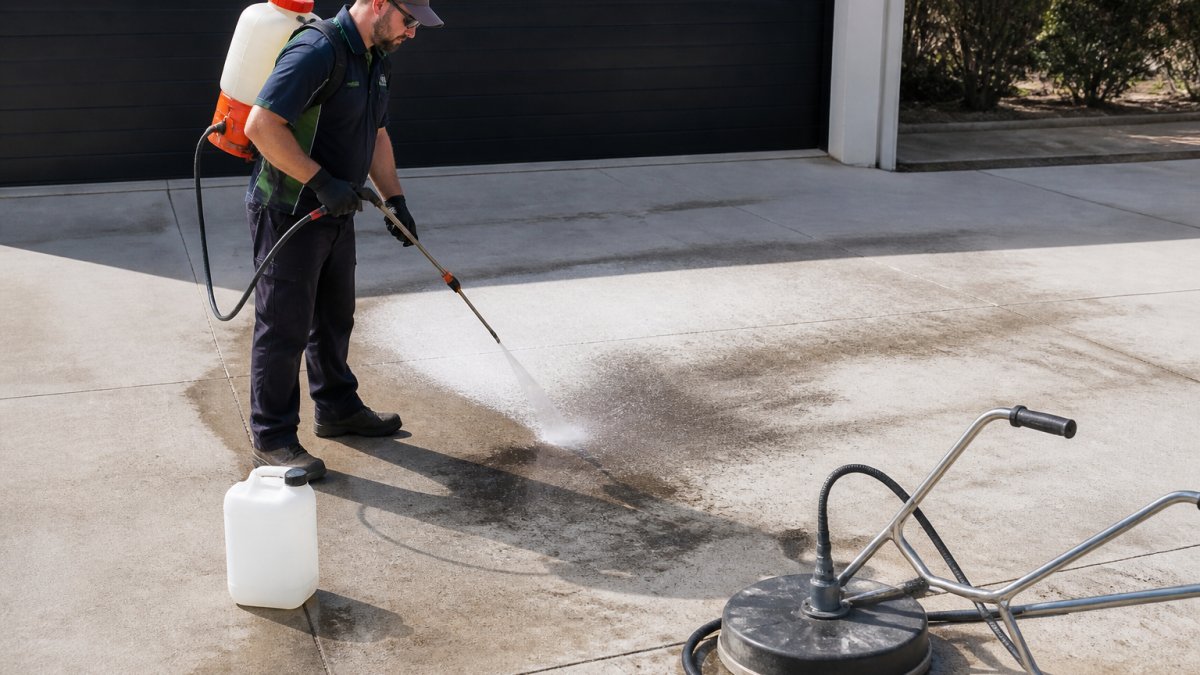
Start by choosing the right degreaser. Look for products designed for concrete and heavy oil.
After the dwell time, agitate the area gently with a stiff brush. This mechanical action helps the degreaser work more effectively.
Here's what makes the difference between a stain that disappears and one that fades but lingers:
- Fresh stains (under 1 week): Usually respond to one degreaser treatment
- Medium-age stains (1-6 months): Need repeated treatment or stronger degreasers
- Old stains (over 6 months): Require multiple applications and often pressure washing afterward
Many homeowners make the mistake of skipping the dwell time or using too weak a degreaser. The chemical needs time to work.
Pressure Washing Oil Stains from a Driveway
Once you've applied degreaser and let it work, pressure washing removes the broken-down oil and residue.
Use a pressure washer set to a moderate level (around 2000-3000 PSI for concrete) after chemical treatment.
The sequence matters. Chemical treatment first, then pressure washing second.
For heavily soiled areas with multiple stains or old oil marks, you may need to repeat the cycle: apply degreaser, wait, agitate, rinse, and inspect.
Best Oil Stain Remover for Concrete
There is no single best oil stain remover for concrete. The right product depends on the stain's age, the surface type, and whether the area drains to stormwater. What separates a product that works from one that disappoints is usually how it is applied, not the brand on the label.
The three product families worth knowing
- Enzymatic degreasers. These use biological agents to break down oil over time. They are gentler on surrounding surfaces and often preferred near gardens, but they need longer dwell times, commonly 30 to 60 minutes, and work best in mild temperatures. They are less effective on old, oxidised stains.
- Solvent-based degreasers. These dissolve oil quickly and suit fresh spills and heavy deposits. They evaporate faster, so dwell time is shorter, often 10 to 20 minutes. They can damage some sealers and painted surfaces, so a patch test is essential.
- Alkaline or caustic concrete cleaners. These are the heavy-duty option for old, deeply absorbed stains. They are aggressive and require protective equipment, and they must never be allowed to dry on the surface. Rinse thoroughly and contain the runoff.
Label-directed dilution and dwell time
Always dilute and apply according to the manufacturer's label. Concentrated degreasers are usually mixed at ratios between 1:4 and 1:10 for general driveway use, and stronger for old stains, but the label is the authority.
Dwell time matters as much as dilution. A common pattern is:
- Fresh stains: 10 to 20 minutes
- Medium-age stains: 20 to 30 minutes
- Old or oxidised stains: 30 to 60 minutes, reapplied if the surface starts to dry
Never let a degreaser dry on concrete. If it begins to dry, mist lightly or reapply, then agitate with a stiff brush and rinse before the product dries.
Patch-test before you commit
Test any unfamiliar product on a small, inconspicuous area first, especially on sealed, coloured, or exposed-aggregate concrete. Wait for the area to dry completely and inspect for dulling, colour change, or sealer damage. A patch test takes minutes and prevents an expensive mistake across an entire driveway.
Surface compatibility at a glance
- Plain concrete: Most concrete-safe degreasers are suitable. Avoid acid-based products on young concrete.
- Sealed concrete: Use sealer-safe or neutral products. Solvent degreasers can strip the sealer.
- Pavers: Test first; some pavers are colour-through, others are surface-coated and can fade.
- Asphalt: Use products labelled asphalt-safe. Solvent degreasers can soften bitumen.
If you are unsure which product suits your surface, a professional assessment is cheaper than replacing a damaged driveway.
Removing Old Oil Stains from Concrete
Old stains, those that have sat for months or years, require patience and a different mindset.
Your realistic goal with old stains is significant lightening, not perfect removal.
For deeply embedded stains, consider multiple treatments over several weeks.
In rare cases, grinding or resurfacing the concrete is the only way to fully remove an old stain.
Prevention is easier than removal. If you've just treated an old stain, protect the area with a concrete sealer.
Soft Washing Versus Pressure Washing for Oil Removal
The direct answer to whether soft washing removes oil stains is: partly, and usually not completely. Soft washing can treat oil chemically, because the cleaning agent does the work at low pressure, but it may not remove deeply embedded oil without agitation, heat, or a rinse step that lifts the broken-down residue. For fresh surface spills, a soft wash with a suitable degreaser can be enough. For old or absorbed stains, expect lightening rather than full removal.
What each method actually does to oil
- Soft washing (under 500 PSI). Low pressure delivers chemical to the surface without forcing water into pores. It relies on dwell time and the degreaser to break the oil's bond. It is safe on render, cladding, roof tiles, painted surfaces, and sealed concrete. Its limit is mechanical: without agitation or a rinse that lifts residue, some oil remains in the pore structure.
- Pressure washing (around 2,000 to 3,000 PSI for concrete). Higher pressure physically flushes broken-down oil and residue from the surface. It is effective as a follow-up to chemical treatment but ineffective as a first step, because pressure alone cannot break the chemical bond between oil and concrete. Too much pressure pits and erodes concrete.
- Heat and steam. Hot water or steam lowers oil viscosity and improves chemical action, which helps on old stains. It is not a substitute for degreaser, but it shortens dwell time and improves results on oxidised oil.
Surface-specific guidance
The right method depends on the surface, not just the stain:
- Concrete driveways: Degreaser first, then pressure washing at moderate pressure. Soft washing alone will lighten but may not fully remove old stains.
- Pavers: Soft washing with a paver-safe degreaser is safer than high pressure, which can dislodge joint sand and damage surface coatings. Agitate with a soft brush and rinse.
- Asphalt: Avoid high pressure, which can gouge bitumen. Use an asphalt-safe degreaser, gentle agitation, and low-pressure rinsing. Soft washing is the safer choice here.
- Sealed surfaces: Soft washing protects the sealer. Pressure washing can strip sealers, so keep pressure low and use sealer-safe products.
A stain-age and severity decision guide
- Fresh spill (under 1 week): Blot, apply degreaser, dwell, agitate, rinse. Soft washing can handle this on delicate surfaces; pressure washing is fine on concrete.
- Medium-age stain (1 to 6 months): Degreaser with longer dwell, agitation, then pressure washing on concrete. Repeat if needed.
- Old or oxidised stain (over 6 months): Multiple treatment cycles, heat or steam where available, and pressure washing on concrete. Expect a residual shadow.
- Deeply absorbed stain: Chemical treatment plus mechanical action; in rare cases resurfacing is the only full fix.
Runoff and environmental precautions
Oily wash water and degreaser residue should not enter stormwater drains. Contain runoff where possible using drain covers, booms, or by directing water to a landscaped area that does not drain to stormwater. Check the product label for aquatic toxicity and follow local environmental guidance. This is a practical step many guides skip, and it matters as much as the cleaning method itself.
A professional assessment can confirm which method suits your surface before any chemical is applied.
Preventing Oil Stains and Protecting Your Surfaces
The best oil stain is one that never happens. Prevention is far simpler than removal.
Keep your driveway and garage floor sealed with a concrete protectant.
Maintain vehicles regularly to catch leaks early.
For new oil spills, act fast. The first few hours matter.
Runoff and environmental impact matter too.
A preventive approach keeps your surfaces looking sharp and protects your investment in your property.
Frequently Asked Questions
Can soft washing remove old oil stains from concrete?
Soft washing alone is not established as a reliable method for removing oil stains, whether fresh or old. Soft washing uses low-pressure water with detergent and is effective for organic growth like algae and mould, but oil requires chemical breakdown. Old stains are particularly resistant because the oil has absorbed deeper into the concrete's pores. Pressure washing combined with degreasers or enzymatic detergents is more effective, especially with adequate dwell time to allow the chemical to break down the oil before rinsing.
What is the best thing to use to remove oil stains from a driveway?
A degreaser or enzymatic detergent combined with pressure washing delivers the best results. Apply the degreaser and let it sit (dwell time) to break down the oil, then use pressure washing to rinse away the loosened residue. For stubborn or old stains, repeat the treatment. Hot water or steam increases effectiveness by helping the chemical penetrate and dissolve oil more thoroughly than cold water alone. The combination of chemical treatment and mechanical action removes far more oil than water pressure by itself.
Will pressure washing remove oil stains from a driveway?
Pressure washing can lighten or partially remove many oil stains, but results depend on the stain's age and the source of the leak. Fresh spills respond better than embedded stains that have sat for months or years. Pressure washing alone is not a complete solution; degreasers or enzymatic detergents must be applied first to break down the oil chemically. Without pre-treatment, pressure washing may only remove surface-level dirt and leave the stain shadow visible. Combining pressure washing with proper chemical treatment is far more effective.
What is the difference between soft washing and pressure washing for oil stains?
Soft washing uses low pressure (typically under 100 PSI) with detergent and is designed for delicate surfaces like render, cladding, and roof tiles. Pressure washing uses higher water pressure (2500-4000 PSI) and is better suited for heavy grime and embedded stains on concrete and driveways. For oil stains specifically, pressure washing is more effective because the higher pressure combined with degreasers can break down and flush away absorbed oil. Soft washing is safer for protecting surfaces from damage but lacks the mechanical force needed to remove oil effectively.
Oil stains don't have to be permanent. Whether your driveway has fresh spills or years-old marks, the right treatment approach makes a real difference. If you're unsure whether your stains need soft washing, pressure washing, or chemical treatment, we're here to help. Get a free on-site quote from JetSet Power Washing and let our team assess your specific situation. We'll provide a transparent, fixed-price plan in writing so you know exactly what to expect.