 blog
How to Choose the Best Driveway Cleaning Solution in Cairns
Quick Summary
The best driveway cleaning solutions in Cairns depend on the surface, not just the stain. Plain concrete suits pressure washing with a degreaser at medium to high pressure, while pavers and sealed concrete need low-pressure or soft-wash methods to avoid damage.
- Concrete tolerates higher pressure, around 2,000 to 3,000 PSI, while pavers stay under about 1,500 PSI.
- Sealed concrete needs a soft wash under about 1,200 PSI to protect the sealant.
- New concrete typically needs around 28 days to cure before pressure washing.
- Never pressure wash asbestos-cement sheeting; wet it down and seek professional advice instead.
- Keep detergent runoff out of stormwater drains and check local council requirements first.
Table of Contents
- Why Cairns Driveways Need a Different Approach
- Driveway Cleaning Solutions Compared by Surface Type
- How to Clean a Concrete Driveway Step by Step
- Driveway Cleaning Solutions for Oil Stains
- How to Remove Red Dirt Stains from Driveway Pavers
- How Often to Pressure Wash a Driveway
- Booking a Driveway Clean: What to Expect from JetSet Power Washing
- Frequently Asked Questions
Why Cairns Driveways Need a Different Approach
Choosing the best driveway cleaning solution in Far North Queensland starts with the climate. Humidity, heavy wet seasons and intense sun all work against concrete and pavers at once. Mould, algae and red dirt can build up on driveways.
A driveway's surface and the type of stain are important considerations when choosing a cleaning method.
Most people focus on the machine. The surface and the stain matter more. Concrete, pavers and sealed finishes each respond differently, and using the wrong approach can etch, strip or lift the material.
Driveway Cleaning Solutions Compared by Surface Type
Each surface needs its own approach. Concrete tolerates higher pressure, while pavers and sealed surfaces need gentler settings and careful joint management. The table below compares the common options, and the notes underneath cover the condition checks and cost decisions that a table alone cannot capture.
| Surface | Recommended Method | Pressure Level | Best For | Watch Out For |
|---|---|---|---|---|
| Plain concrete | Pressure washing with degreaser | Medium to high (approx. 2,000-3,000 PSI) | Mould, dirt, oil | Etching and stripes if the nozzle dwells |
| Pavers | Low-pressure wash with pre-treatment | Low to medium (under approx. 1,500 PSI) | Red dirt, algae, joint weed | Sand loss from joints; loosened layout |
| Sealed concrete | Soft wash with mild detergent | Low (under approx. 1,200 PSI) | Preserving the sealant | Stripping the sealer; cloudiness |
| Heavily stained areas | Targeted pre-treatment, then rinse | Medium | Oil and tyre marks | Discolouration from strong chemicals |
Check the condition before you choose a method
Pressure washing is not suitable for every driveway. Walk the surface first and look for:
- New concrete. Concrete typically needs around 28 days to cure before it should be pressure washed. Washing too early can damage the surface layer.
- Cracks and spalling. Loose or flaking concrete can be broken up by pressure. Use lower pressure and avoid directing the jet into cracks.
- Existing coatings. Paint, epoxy and sealers can lift under pressure. Test a small patch and use the lowest setting that works.
- Older or unknown materials. If the driveway may contain asbestos-cement sheeting, do not pressure wash it. Wet it down and seek professional advice.
- Drainage. If the driveway slopes toward the house or a neighbour's property, plan where the runoff will go before you start.
DIY versus professional: the cost trade-off
If you are unsure which category your driveway falls into, a professional inspection will confirm it. JetSet Power Washing offers free on-site quotes, which includes checking the surface before any work begins.
How to Clean a Concrete Driveway Step by Step
A good result depends on preparation as much as the wash itself. The steps below assume a typical residential concrete driveway and a consumer or hire-shop pressure washer rated around 2,000-3,000 PSI (roughly 140-210 bar). Work through them in order, and test a small inconspicuous area before committing to the full surface. If you would rather hand the job to professionals after reading these steps, you can learn how to book professional driveway cleaning and compare options and costs.
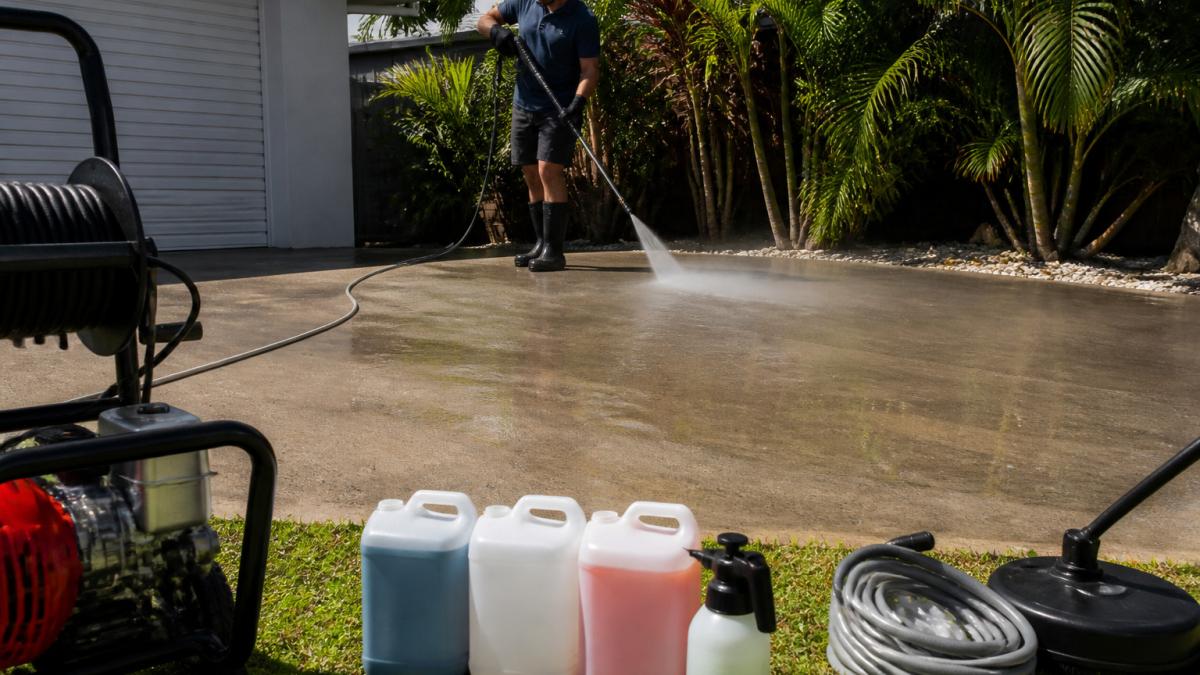
- Clear the area. Move vehicles, bins and loose items. Cover nearby plants and light fittings with plastic sheeting, and close windows and doors on that side of the house. Sweep up any loose gravel so it does not become a projectile.
- Sweep thoroughly. Remove leaves, grit and loose debris so the wash does not push it into the surface or into stormwater drains. Bag the sweepings rather than hosing them into the gutter.
- Pre-treat stains. Apply a suitable degreaser to oil marks and a mould or algae treatment to green patches. Let each product sit for the dwell time on the label, typically 5-15 minutes for consumer degreasers, longer for heavy mould. Do not let product dry on the surface; mist it if needed.
- Set up safely. Wear closed shoes, eye protection and gloves. Keep the lance pointed down and away from people, pets and glass. Never direct the jet at electrical fittings, gas meters or air-conditioning units.
- Start at the far end. Work toward the exit so you do not walk over cleaned sections. Use a fan pattern (typically a 25° or 40° nozzle for concrete) rather than a pencil jet, which concentrates pressure and etches.
- Use consistent passes. Keep the nozzle at a steady angle and distance, around 20-30 cm from the surface is a common starting point. Overlap each pass by about half the fan width. Keep the wand moving; dwelling in one spot is what causes stripes and etching.
- Rinse fully. Remove all detergent residue. Leftover product can attract dirt faster and may leave a film once dry.
- Manage runoff. In most Australian jurisdictions, detergent-laden runoff should not enter stormwater drains, which typically discharge to waterways. Where possible, wash onto a lawn or garden bed, or use a wet-vacuum or bund to capture runoff. Check your local council's requirements before using detergents near drains.
- Let it dry. Allow the surface to dry for at least 24 hours before parking or sealing. Sealing a damp slab traps moisture and can cause cloudiness.
Driveway Cleaning Solutions for Oil Stains
Oil stains can be difficult to remove from driveways.
Removing Stubborn Oil Stains Without Damaging the Surface
Fresh oil is far easier to remove than old oil, so treat leaks as soon as they appear.
How to Remove Red Dirt Stains from Driveway Pavers
Red dirt can stain driveway pavers. You can see examples of pressure washing work on similar driveways across the region.
Start by sweeping and removing loose soil. Then apply a pre-treatment suited to iron-rich staining, let it sit, and work it in with a soft brush. Finish with a low-pressure rinse, working across the paver direction rather than along the joints. Expect some residue to remain in deeper joints, which may need a second pass.
How Often to Pressure Wash a Driveway
Regular light cleaning is easier and cheaper than occasional heavy restoration. Waiting until the surface is green or deeply stained usually means more product and more effort.
Booking a Driveway Clean: What to Expect from JetSet Power Washing
JetSet Power Washing offers free on-site quotes and provides a fixed price in writing.
JetSet Power Washing responds the same business day and is fully insured. You can check service areas and booking options for driveway cleaning in your town. If you are ready to proceed, you can request a free driveway cleaning quote for your property.
Frequently Asked Questions
How often do you need to pressure wash a driveway?
Pricing depends on the size and condition of the area, so visit the JetSet Power Washing website or request a free on-site quote for current prices.
Is pressure washing safe for a concrete driveway?
A site inspection before the job helps determine what is safe for your particular surface.
What cleaning solution is safe to use on a driveway?
A pH-balanced driveway cleaner is the safest general option for concrete and pavers, because it lifts grime without stripping the surface. Harsh caustic cleaners can discolour pavers and damage the sealant on some surfaces. For oil stains, a degreaser applied as a pre-treatment is often used before rinsing. Avoid mixing cleaners, and rinse thoroughly afterwards so residue does not attract new dirt. Professional operators choose products based on the surface, which is why a tailored approach is recommended.
When should you hire a professional to clean a driveway?
JetSet Power Washing provides a fixed price in writing. For a quote or to book a clean, contact JetSet Power Washing directly.