 blog
blog
Commercial exterior cleaning in Cairns: what to know
Table of Contents
- What commercial exterior cleaning services cover
- Pressure washing versus soft washing: safe for paint and render
- Can you pressure wash painted timber fences without peeling
- Commercial property exterior cleaning costs and budgeting
- Safety standards and insurance for professional cleaners
- How to choose a reliable exterior cleaning contractor
- Maintenance schedules for commercial property exteriors
- Frequently Asked Questions
Last Updated: September 21, 2026
What commercial exterior cleaning services cover
Commercial exterior cleaning encompasses a broad range of services designed to maintain the appearance and integrity of business properties. These services typically include pressure washing driveways and carparks, soft washing building facades and render, roof cleaning for tiles and metal panels, and window cleaning for multi-storey buildings. Many facility managers find that bundling these services creates efficiency, a single contractor can assess the entire property and develop a comprehensive cleaning plan rather than coordinating multiple specialists.
The scope extends beyond aesthetics. Professional commercial exterior cleaning removes accumulated dirt, mould, mildew, oil stains, and biological growth that can damage surfaces over time. Tropical climates accelerate this deterioration, making regular maintenance essential. A property that looks neglected signals poor management to clients and tenants, whilst a well-maintained exterior builds confidence and supports property values.
JetSet Power Washing handles commercial exterior cleaning needs, from removing oil and tyre marks from industrial yards to soft washing delicate painted render on office buildings. The key distinction between commercial and residential work is scale and complexity, commercial properties often have mixed surface types requiring different pressure levels and cleaning solutions.
Pressure washing versus soft washing: safe for paint and render
The choice between pressure washing and soft washing determines whether your surfaces emerge spotless or damaged. Pressure washing uses high-velocity water jets, typically 1500-3000 PSI, to blast away stubborn contaminants. Soft washing applies lower pressure (under 500 PSI) combined with biodegradable cleaning solutions, allowing chemicals to do the work rather than force.
Pressure washing excels on concrete, asphalt, and metal surfaces that can withstand impact. It removes oil stains, tyre marks, and ingrained dirt efficiently. However, painted timber, render, and delicate cladding require soft washing. High pressure can strip paint, crack render, and force water behind cladding where it causes hidden moisture damage. The mistake many property owners make is assuming higher pressure always cleans better, in reality, applying 3000 PSI to render is like using a fire hose on a watercolour painting.
Soft washing protects vulnerable surfaces whilst delivering excellent results. The cleaning solutions break down organic growth like mould and mildew at the chemical level, so gentle water pressure completes the job. For commercial properties with mixed exterior finishes, a contractor experienced in both methods can assess each surface and apply the appropriate technique. JetSet Power Washing uses this tailored approach, selecting soft wash for render, and pressure washing for concrete surfaces on the same property.
Can you pressure wash painted timber fences without peeling
Painted timber fences are one of the most commonly damaged surfaces when pressure washing goes wrong. High pressure forces water into the wood grain, lifting paint and creating splintering edges that look worse than the original dirt. The answer is straightforward: soft washing is the correct method for painted timber.
Soft washing painted timber involves applying a biodegradable cleaning solution that kills mould spores and loosens dirt without mechanical force. After the solution has worked for 15-20 minutes, low-pressure rinsing removes the debris and cleaning agent. The paint remains intact, and the wood is left clean and protected. This method takes longer than pressure washing but preserves the surface and extends the life of the paint coating.
Property managers often ask whether soft washing actually removes stubborn stains on timber. The answer depends on the stain type. Organic growth like mould and mildew responds excellently to soft washing. Oil stains and weathered grey discolouration may require specialist treatments or acceptance that some marks are permanent features of aged timber. The critical insight is that pressure washing will always damage painted timber, it's not a matter of technique or operator skill, it's physics. A contractor who offers to pressure wash your painted fence is either inexperienced or willing to risk your property for speed.
Commercial property exterior cleaning costs and budgeting
Pricing for commercial exterior cleaning depends on property size, surface types, contamination level, and access difficulty. A small office building with straightforward concrete driveways costs significantly less than a sprawling industrial site with multiple roof levels and specialised equipment requirements. Rather than guessing, facility managers should request free on-site quotes that account for their specific property conditions.
When budgeting, consider that commercial exterior cleaning is preventative maintenance, not discretionary spending. Regular cleaning extends surface lifespan, prevents costly repairs from water damage or structural deterioration, and maintains property appearance for client impressions and tenant satisfaction. A property that's cleaned annually costs far less to maintain than one that's neglected for five years and requires restoration work.
Many commercial property managers establish recurring cleaning contracts rather than one-off services. Quarterly or bi-annual pressure washing of carparks and driveways, combined with annual roof and facade cleaning, creates predictable budget lines. JetSet Power Washing provides fixed-price quotes in writing, eliminating surprise costs when the work is complete. This transparency helps facility managers forecast expenses accurately and compare contractor pricing with confidence.
Safety standards and insurance for professional cleaners
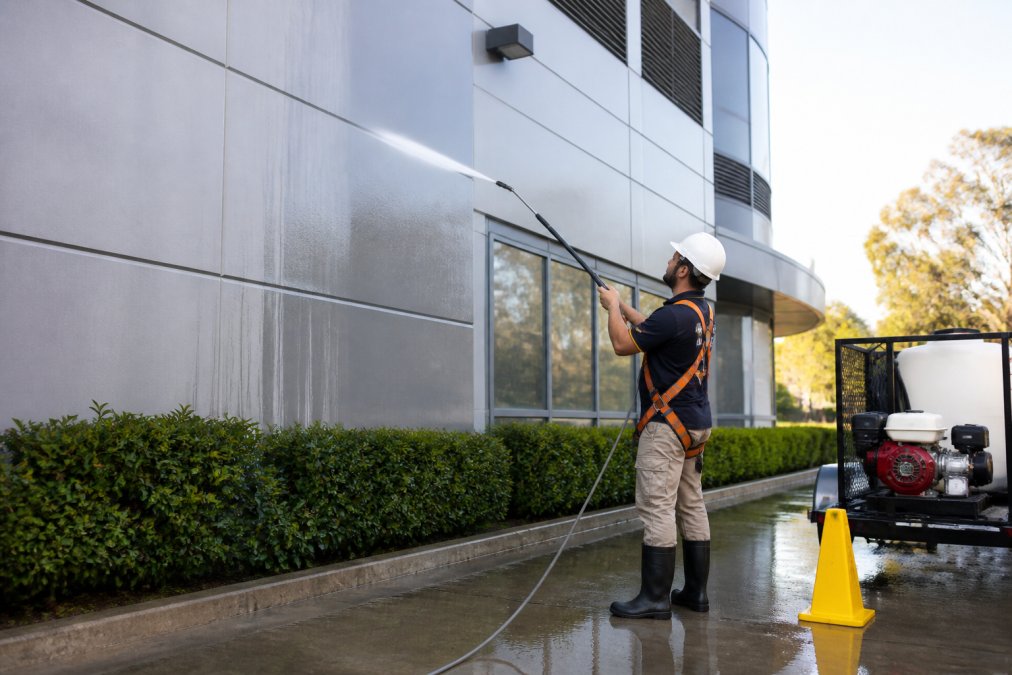
Hiring an uninsured contractor to work at height or with high-pressure equipment creates serious liability exposure. If a cleaner is injured, your property is damaged, or water intrudes into the building, an uninsured contractor leaves you responsible for costs and legal claims. Professional commercial exterior cleaning requires public liability insurance and, for work at height, appropriate safety certifications mandated by Australian workplace law.
Workplace health and safety in Australia is governed by the Work Health and Safety Act 2011 (Cth) and relevant state legislation (Work Health and Safety Regulations 2011). Contractors working at heights above 2 metres must hold a current Working at Height certification or equivalent competency. High-pressure equipment operation carries specific hazard controls: operators must wear appropriate personal protective equipment (safety glasses, steel-capped boots, high-visibility clothing), maintain safe distances from electrical hazards and power lines, and follow manufacturer guidelines for equipment pressure settings. Roof work demands fall arrest systems, properly installed anchor points, and documented risk assessments before work begins.
Environmental compliance is equally critical for exterior cleaning in tropical climates. The Environmental Protection Act 1994 (Queensland) requires contractors to manage wastewater runoff responsibly. Pressure washing and soft washing generate contaminated water containing detergents, oils, mould spores, and debris. Responsible contractors implement containment measures such as bunding, sediment traps, or directing runoff to appropriate drainage rather than allowing it to flow into stormwater systems or neighbouring properties. This is not optional, it's a legal obligation that protects waterways and demonstrates environmental stewardship.
When selecting a contractor, request proof of:
- Current public liability insurance (minimum $10 million for commercial work)
- Working at Height certification or equivalent competency card
- Evidence of environmental compliance procedures (ask how they manage wastewater)
- Site-specific risk assessments conducted before quoting
A thorough pre-work inspection demonstrates professionalism and reduces risk. Does the contractor identify hazards like power lines, fragile roof materials, water drainage paths, and neighbouring properties that could be affected by runoff? Do they discuss containment measures and environmental safeguards before work begins? JetSet Power Washing carries full public liability insurance and implements environmental controls including responsible wastewater disposal. Every job includes a documented site assessment and risk management plan, ensuring compliance with Australian workplace and environmental standards.
How to choose a reliable exterior cleaning contractor
Selecting a contractor involves evaluating experience, responsiveness, pricing transparency, and safety practices. Start by requesting quotes from multiple providers, at least three allows meaningful comparison. A reliable contractor visits your property in person, assesses surface types and contamination levels, and provides a written quote that specifies what's included and what's not.
Responsiveness matters more than most property managers realise. A contractor who returns calls within hours and provides same-business-day responses demonstrates respect for your time and schedule. Delays in communication often signal disorganisation or overcommitment. Ask about their typical response time and whether they can accommodate your preferred scheduling window.
Pricing should be transparent and fixed. Avoid contractors who quote low prices then claim "extra work" discovered on-site justifies additional charges. A professional conducts a thorough assessment upfront and provides a complete quote. If unexpected issues emerge during work, a reliable contractor discusses them with you before proceeding, rather than presenting a surprise bill.
Experience matters, a contractor with 5+ years handling commercial properties understands the challenges of large-scale work, mixed surface types, and tight scheduling. Ask about their experience with your property type: industrial yards, office buildings, retail centres, and medical facilities each have distinct requirements.
Maintenance schedules for commercial property exteriors
A baseline maintenance framework for commercial properties includes:
Quarterly (every 3 months): Pressure washing of driveways, carparks, and concrete surfaces. Oil stains, tyre marks, and dirt accumulate rapidly in high-traffic areas, and quarterly cleaning prevents buildup that becomes harder to remove. Industrial sites with machinery or heavy vehicle traffic often require monthly cleaning instead.
Frequently Asked Questions
What is the difference between pressure washing and soft washing for commercial buildings?
Pressure washing uses high-pressure water jets (2500+ PSI) to remove stubborn stains, oil, and grime from concrete, driveways, and industrial surfaces. Soft washing applies lower pressure combined with cleaning solutions to safely treat delicate surfaces like painted render, cladding, and timber without risk of damage. For most commercial exteriors, a combination of both methods works best, soft wash for facades and high-pressure wash for ground-level surfaces.
How often should commercial properties have their exterior cleaned?
Most commercial properties benefit from exterior cleaning every 6 to 12 months, depending on local climate, facility type, and visible dirt accumulation. Properties in humid tropical areas, near industrial sites, or with high foot traffic may require quarterly cleaning. Medical centres, showrooms, and customer-facing facilities typically need more frequent cleaning to maintain professional appearance. A professional contractor can assess your property and recommend a maintenance schedule suited to your needs.
Is soft washing safe for Colorbond and metal roofs?
Yes, soft washing is safe for Colorbond and metal roofs when performed by experienced contractors. The method uses low pressure and specialised cleaning solutions to remove moss, mildew, and staining without damaging the protective coating. High-pressure washing can strip protective layers and cause rust, so soft wash is the preferred approach for metal roof surfaces. Always confirm your contractor has experience with metal roof cleaning before booking.
What should I look for in a commercial exterior cleaning contractor?
Choose a contractor with public liability insurance, workplace health and safety certification, and verifiable experience with commercial facilities similar to yours. Request a site assessment and fixed-price quote in writing before work begins. Check their response time, reliable contractors respond same-business-day to enquiries. Ask about their equipment (trade-grade is essential), their approach to different surfaces, and whether they offer preventative maintenance contracts. References or reviews from other commercial clients are valuable proof of reliability.